Secondary menu

  • About Us
  • News & Stories
  • Translated Materials
Minnesota Department of Health logo
  • Data, Statistics, and Legislation

    Data, Statistics, and Legislation

    Statistical reports, health economics, policy, and legislation.
    Data, Statistics, and Legislation
    • Community Health
    • Diseases and Conditions
    • Environmental Health
    • Health Behaviors and Risk Factors
    • Health Care Cost and Quality
    • Reporting and Exchanging Data
    • Legislation and Policy
  • Diseases and Conditions

    Diseases and Conditions

    A-Z disease listing, diseases and conditions by type.
    Diseases and Conditions
  • Health Care Facilities, Providers, and Insurance

    Health Care Facilities and Providers

    Directories of facilities, professional certifications, health insurance and patient safety.
    Health Care Facilities and Providers
    • Facility Certification, Regulation and Licensing
    • Insurance
    • Health Information Technology
    • Provider Certifications, Licenses, Registrations and Rosters
    • Patient Health and Safety
    • Health Care Homes
    • Notices Related to Health Records
    • Rural Health and Primary Care
    • Trauma System
  • Healthy Communities, Environments, and Workplaces

    Healthy Communities, Environments, and Workplaces

    Indoor air and drinking water quality, community prevention and emergency preparedness.
    Healthy Communities, Environments, and Workplaces
    • Community Wellness and Health Equity
    • Healthy Schools and Child Care
    • Healthy Businesses and Workplaces
    • Local Public Health
    • Environments and Your Health
    • Safety and Prevention
    • Emergency Preparedness and Response
    • Equitable Health Care Task Force
    • Transforming the Public Health System in Minnesota
  • Individual and Family Health

    Individual and Family Health

    Birth records, immunizations, nutrition and physical activity.
    Individual and Family Health
    • Vital Records and Certificates
    • Disabilities and Special Health Needs
    • Disease Prevention and Symptom Management
    • Healthy Aging
    • Healthy Children, Youth and Adolescents
    • Mental Health and Well-being
    • Reproductive Rights and Protections in Minnesota
    • Women and Infants
MDH Logo

Breadcrumb

  1. Home
  2. Diseases and Conditions
  3. Infectious Disease Reporting
  4. Minnesota Electronic Disease Surveillance System
  5. MEDSS Training Module: Introduction
Topic Menu

MEDSS Training

  • Introduction
  • Ch. 1: Searching for Events
  • Ch. 2: Creating New Events
  • Ch. 3: Event Specific Data
  • Ch. 4: Modifying Person
  • Ch. 5: Linking Events
  • Ch. 6: Workflow Queues
  • Ch. 7: Tasks
  • Ch. 8: Sharing Events
  • Ch. 9: ELR
  • Ch. 10: Data Out - Reports
  • Conclusion

MEDSS

  • Home
  • MEDSS Overview
  • Electronic Lab Reporting
  • Electronic Case Reporting
  • MEDSS Training Resources
  • MEDSS FAQs

Related Topics

  • Infectious Diseases A-Z
  • Reportable Infectious Diseases
  • e-Health

MEDSS Training

  • Introduction
  • Ch. 1: Searching for Events
  • Ch. 2: Creating New Events
  • Ch. 3: Event Specific Data
  • Ch. 4: Modifying Person
  • Ch. 5: Linking Events
  • Ch. 6: Workflow Queues
  • Ch. 7: Tasks
  • Ch. 8: Sharing Events
  • Ch. 9: ELR
  • Ch. 10: Data Out - Reports
  • Conclusion

MEDSS

  • Home
  • MEDSS Overview
  • Electronic Lab Reporting
  • Electronic Case Reporting
  • MEDSS Training Resources
  • MEDSS FAQs

Related Topics

  • Infectious Diseases A-Z
  • Reportable Infectious Diseases
  • e-Health
Contact Info
Infectious Disease Epidemiology, Prevention and Control Division
651-201-5414
IDEPC Comment Form

Contact Info

Infectious Disease Epidemiology, Prevention and Control Division
651-201-5414
IDEPC Comment Form

Chapter Seven: Adding and Editing Tasks

A task within MEDSS is a technique for users to delegate assignments or work to others. There are two different types of tasks in the system: event assignments or action tasks (both associated with an event and non-event specific). There are multiple places in the system where tasks can be created and each method is explained in more detail in Chapter 8 of the Basic Training Manual for MEDSS (PDF).

Follow the steps below for adding an event specific task from the dashboard:

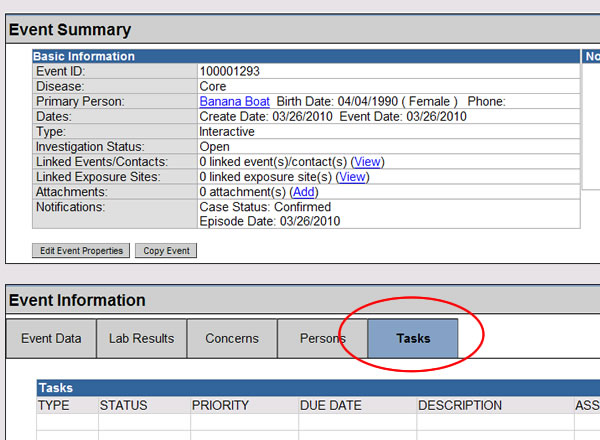
  1. With an event open on the dashboard, click on the Task Tab.

  2. tasks
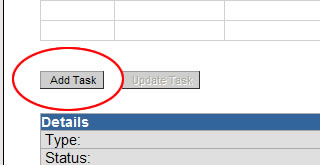
  3. Click on Add Task.

  4. tasks
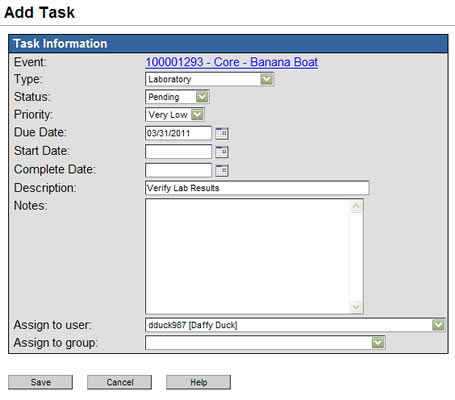
  5. A new screen appears where a user can define the task. The required fields are the type of task and the assignee. An assignment type means assigning an entire event to an individual, but the other types designate an action task.

  6. tasks
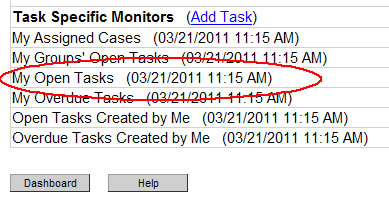
  7. Click Save when finished. The assignee or group will receive an email notification of the new event specific task. The task will appear in that user's "My Open Tasks" workflow.
tasks

Follow the steps below to edit a task:

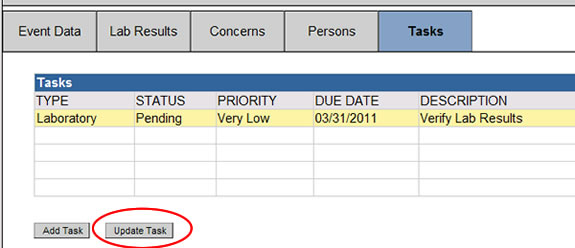
  1. On the dashboard for the event, highlight the task under the task tab and click on Update Task.

  2. tasks
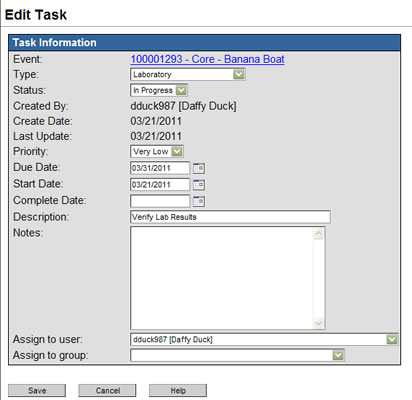
  3. This opens the Edit Task window. Edit the task by changing the status or entering a start date. When finished, click Save.

  4. tasks
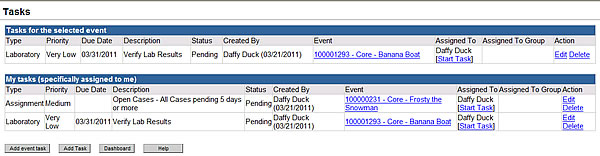
  5. task iconThe other option to edit tasks is to click on the task icon in the toolbar.

  6. A new screen opens with the tasks associated with the open event on the top and all the tasks assigned to the current user on the bottom. Click on Edit in the right action column to open the Edit Task window (image seen above).
tasks

Next page: Chapter 8: Sharing Events

Tags
  • reportable
Last Updated: 10/20/2022
  • Facebook
  • X
  • Instagram
  • LinkedIn
  • Youtube

About MDH

  • About Us
  • Grants and Loans
  • Advisory Committees

Legal & Accessibility

  • Privacy Policy
  • Equal Opportunity
  • Feedback Form

Careers at MDH

This is an official website of the State of Minnesota. Visit Minnesota.gov for more information.