
Secondary menu

  • About Us
  • News & Stories
  • Translated Materials
Minnesota Department of Health logo
  • Data, Statistics, and Legislation

    Data, Statistics, and Legislation

    Statistical reports, health economics, policy, and legislation.
    Data, Statistics, and Legislation
    • Community Health
    • Diseases and Conditions
    • Environmental Health
    • Health Behaviors and Risk Factors
    • Health Care Cost and Quality
    • Reporting and Exchanging Data
    • Legislation and Policy
  • Diseases and Conditions

    Diseases and Conditions

    A-Z disease listing, diseases and conditions by type.
    Diseases and Conditions
  • Health Care Facilities, Providers, and Insurance

    Health Care Facilities and Providers

    Directories of facilities, professional certifications, health insurance and patient safety.
    Health Care Facilities and Providers
    • Facility Certification, Regulation and Licensing
    • Insurance
    • Health Information Technology
    • Provider Certifications, Licenses, Registrations and Rosters
    • Patient Health and Safety
    • Health Care Homes
    • Notices Related to Health Records
    • Rural Health and Primary Care
    • Trauma System
  • Healthy Communities, Environments, and Workplaces

    Healthy Communities, Environments, and Workplaces

    Indoor air and drinking water quality, community prevention and emergency preparedness.
    Healthy Communities, Environments, and Workplaces
    • Community Wellness and Health Equity
    • Healthy Schools and Child Care
    • Healthy Businesses and Workplaces
    • Local Public Health
    • Environments and Your Health
    • Safety and Prevention
    • Emergency Preparedness and Response
    • Equitable Health Care Task Force
    • Transforming the Public Health System in Minnesota
  • Individual and Family Health

    Individual and Family Health

    Birth records, immunizations, nutrition and physical activity.
    Individual and Family Health
    • Vital Records and Certificates
    • Disabilities and Special Health Needs
    • Disease Prevention and Symptom Management
    • Healthy Aging
    • Healthy Children, Youth and Adolescents
    • Mental Health and Well-being
    • Reproductive Rights and Protections in Minnesota
    • Women and Infants
MDH Logo

Breadcrumb

  1. Home
  2. Diseases and Conditions
  3. Infectious Disease Reporting
  4. Minnesota Electronic Disease Surveillance System
  5. MEDSS Training Module: Introduction
Topic Menu

MEDSS Training

  • Introduction
  • Ch. 1: Searching for Events
  • Ch. 2: Creating New Events
  • Ch. 3: Event Specific Data
  • Ch. 4: Modifying Person
  • Ch. 5: Linking Events
  • Ch. 6: Workflow Queues
  • Ch. 7: Tasks
  • Ch. 8: Sharing Events
  • Ch. 9: ELR
  • Ch. 10: Data Out - Reports
  • Conclusion

MEDSS

  • Home
  • MEDSS Overview
  • Electronic Lab Reporting
  • Electronic Case Reporting
  • MEDSS Training Resources
  • MEDSS FAQs

Related Topics

  • Infectious Diseases A-Z
  • Reportable Infectious Diseases
  • e-Health

MEDSS Training

  • Introduction
  • Ch. 1: Searching for Events
  • Ch. 2: Creating New Events
  • Ch. 3: Event Specific Data
  • Ch. 4: Modifying Person
  • Ch. 5: Linking Events
  • Ch. 6: Workflow Queues
  • Ch. 7: Tasks
  • Ch. 8: Sharing Events
  • Ch. 9: ELR
  • Ch. 10: Data Out - Reports
  • Conclusion

MEDSS

  • Home
  • MEDSS Overview
  • Electronic Lab Reporting
  • Electronic Case Reporting
  • MEDSS Training Resources
  • MEDSS FAQs

Related Topics

  • Infectious Diseases A-Z
  • Reportable Infectious Diseases
  • e-Health
Contact Info
Infectious Disease Epidemiology, Prevention and Control Division
651-201-5414
IDEPC Comment Form

Contact Info

Infectious Disease Epidemiology, Prevention and Control Division
651-201-5414
IDEPC Comment Form

Chapter Ten: Data Out - Reports

In MEDSS the report function can be used to extract data and see case counts of their events. Each disease group will be able to pull all of their events out of MEDSS to export to a data software program such as Microsoft Excel or SAS. In addition MEDSS offers simple and complex reports to show comparisons and counts that are more generic and disease specific. Individual users may also have permissions to create their own ad-hoc reports to query their data on a one time basis.

Follow the steps below to access and run reports:

  1. report icon From the MEDSS Dashboard, click the Reports icon in the MEDSS toolbar. Reports generally are not based on a specific event; therefore, it is not necessary to have an event selected before running a report.

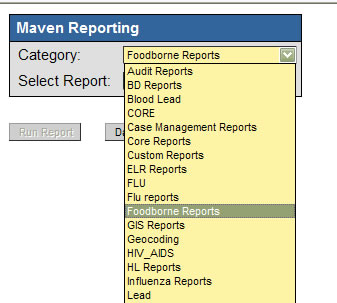
  2. A new screen displays with a dropdown list of different categories. Choose the category that fits your needs. The list will depend on your role and group access.

  3. reporting
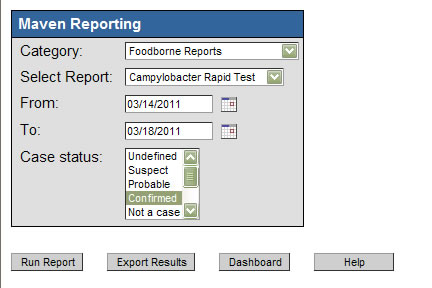
  4. After choosing the category, the Select Report dropdown will populate. Choose the report you need.

  5. Most reports require additional parameters such as case status or start and end dates which help define which cases to include in the report. MEDSS runs midnight to midnight so if you need one day's worth, choose the current date as start date and tomorrow's date as end date, i.e. 03/25/2011 - 03/26/2011.

  6. reporting
  7. Reports can be displayed in a non-editable format within the browser window or can be exported to an external application such as Excel. To see the report open in a new browser window, click on Run Report.

  8. To export the report to Microsoft Excel, click on Export Results. MEDSS will confirm this action and Excel will open. From there users can manipulate, format or graph the results.
Next page: Conclusion

Tags
  • reportable
Last Updated: 10/20/2022
  • Facebook
  • X
  • Instagram
  • LinkedIn
  • Youtube

About MDH

  • About Us
  • Grants and Loans
  • Advisory Committees

Legal & Accessibility

  • Privacy Policy
  • Equal Opportunity
  • Feedback Form

Careers at MDH

This is an official website of the State of Minnesota. Visit Minnesota.gov for more information.