
Secondary menu

  • About Us
  • News & Stories
  • Translated Materials
Minnesota Department of Health logo
  • Data, Statistics, and Legislation

    Data, Statistics, and Legislation

    Statistical reports, health economics, policy, and legislation.
    Data, Statistics, and Legislation
    • Community Health
    • Diseases and Conditions
    • Environmental Health
    • Health Behaviors and Risk Factors
    • Health Care Cost and Quality
    • Reporting and Exchanging Data
    • Legislation and Policy
  • Diseases and Conditions

    Diseases and Conditions

    A-Z disease listing, diseases and conditions by type.
    Diseases and Conditions
  • Health Care Facilities, Providers, and Insurance

    Health Care Facilities and Providers

    Directories of facilities, professional certifications, health insurance and patient safety.
    Health Care Facilities and Providers
    • Facility Certification, Regulation and Licensing
    • Insurance
    • Health Information Technology
    • Provider Certifications, Licenses, Registrations and Rosters
    • Patient Health and Safety
    • Health Care Homes
    • Notices Related to Health Records
    • Rural Health and Primary Care
    • Trauma System
  • Healthy Communities, Environments, and Workplaces

    Healthy Communities, Environments, and Workplaces

    Indoor air and drinking water quality, community prevention and emergency preparedness.
    Healthy Communities, Environments, and Workplaces
    • Community Wellness and Health Equity
    • Healthy Schools and Child Care
    • Healthy Businesses and Workplaces
    • Local Public Health
    • Environments and Your Health
    • Safety and Prevention
    • Emergency Preparedness and Response
    • Equitable Health Care Task Force
    • Transforming the Public Health System in Minnesota
  • Individual and Family Health

    Individual and Family Health

    Birth records, immunizations, nutrition and physical activity.
    Individual and Family Health
    • Vital Records and Certificates
    • Disabilities and Special Health Needs
    • Disease Prevention and Symptom Management
    • Healthy Aging
    • Healthy Children, Youth and Adolescents
    • Mental Health and Well-being
    • Reproductive Rights and Protections in Minnesota
    • Women and Infants
MDH Logo

Breadcrumb

  1. Home
  2. Diseases and Conditions
  3. Unexplained Critical Illnesses and Deaths
  4. Medical Examiner Infectious Deaths Surveillance Program (MED-X)
Topic Menu

MED-X Program

  • MED-X Home
  • Program Description
  • Case Definition
  • Protocol
  • Reporting
  • Specimen Collection
  • Statistics
  • Frequently Asked Questions
  • Resources

Related Topics

  • Unexplained Critical Illnesses and Deaths Home
  • Infectious Diseases A-Z
  • Reportable Infectious Diseases

MED-X Program

  • MED-X Home
  • Program Description
  • Case Definition
  • Protocol
  • Reporting
  • Specimen Collection
  • Statistics
  • Frequently Asked Questions
  • Resources

Related Topics

  • Unexplained Critical Illnesses and Deaths Home
  • Infectious Diseases A-Z
  • Reportable Infectious Diseases
Contact Info
Infectious Disease Epidemiology, Prevention and Control Division
651-201-5414
IDEPC Comment Form

Contact Info

Infectious Disease Epidemiology, Prevention and Control Division
651-201-5414
IDEPC Comment Form

MED-X Frequently Asked Questions

On this page:
What are infectious signs, symptoms, hallmarks of disease?
How does MED-X relate to the UNEX?
How long until I can expect testing results?
How should we store and ship specimens?

What are considered infectious signs and symptoms or hallmarks of disease?

  • Antemortem Signs/Symptoms:
    • Fever
    • Acute encephalopathy or new onset seizures
    • Acute flaccid paralysis or polyneuropathy
    • New-onset jaundice
    • Acute diarrhea
    • New rash or soft tissue lesion
  • Postmortem Syndromes
    • Encephalitis and Meningitis
    • Pharyngitis, epiglottitis, acute bronchitis
    • Pneumonia
    • Myocarditis or Endocarditis
    • Acute hepatitis or fulminant hepatic necrosis
    • Colitis
    • Lymphadenitis
    • Diffuse rash or soft tissue lesion
    • Sepsis syndrome

How does MED-X relate to the Unexplained Deaths and Critical Illness Project (UNEX)?

The MED-X surveillance includes unexplained deaths reported to the UNEX program, but in addition, it includes explained infectious deaths and those deaths that are unexplained in healthy, young individuals regardless of if there are infectious signs and symptoms present (i.e. SIDS cases).
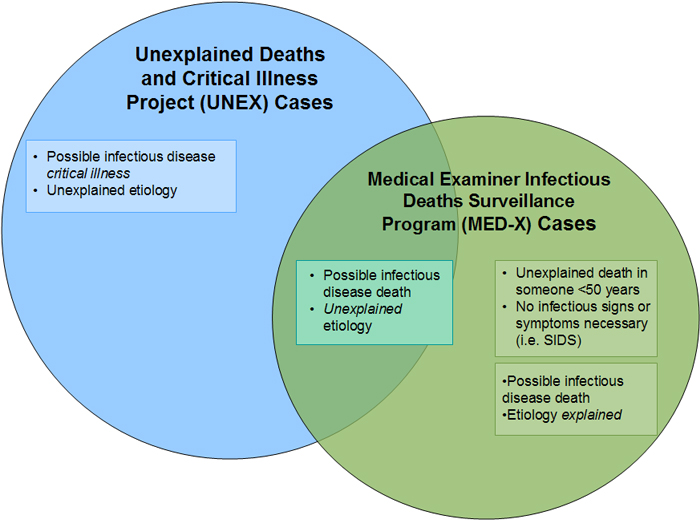
Diagram of Unexplained Deaths and MED-X Projects as explained above.

How long until I can expect testing results?

  • Testing is an ongoing process that often involves several rounds.
    • For viral cultures, results can come back as early as one week and up to 21 days.
    • PCR testing is often conducted here at the MDH laboratory and generally takes about one to two weeks for results.
    • Testing on formalin and paraffin fixed tissue is done at CDC and will take longer to process, from one to several months.
  • Cases sometimes have unique important public health implications and testing is done as rapidly as possible in those instances.

How should we store and ship specimens?

  • MED-X Specimen Collection and Testing.
  • In general, formalin and paraffin tissue should be kept at room temperature. Fresh tissue and fluids can be refrigerated and shipped on ice if sent within 48 hours of collection. Once a specimen has been frozen, it should be kept frozen for shipment.


Tags
  • unexplained critical illnesses and deaths
Last Updated: 07/02/2025
  • Facebook
  • X
  • Instagram
  • LinkedIn
  • Youtube

About MDH

  • About Us
  • Grants and Loans
  • Advisory Committees

Legal & Accessibility

  • Privacy Policy
  • Equal Opportunity
  • Feedback Form

Careers at MDH

This is an official website of the State of Minnesota. Visit Minnesota.gov for more information.