
Secondary menu

  • About Us
  • News & Stories
  • Translated Materials
Minnesota Department of Health logo
  • Data, Statistics, and Legislation

    Data, Statistics, and Legislation

    Statistical reports, health economics, policy, and legislation.
    Data, Statistics, and Legislation
    • Community Health
    • Diseases and Conditions
    • Environmental Health
    • Health Behaviors and Risk Factors
    • Health Care Cost and Quality
    • Reporting and Exchanging Data
    • Legislation and Policy
  • Diseases and Conditions

    Diseases and Conditions

    A-Z disease listing, diseases and conditions by type.
    Diseases and Conditions
  • Health Care Facilities, Providers, and Insurance

    Health Care Facilities and Providers

    Directories of facilities, professional certifications, health insurance and patient safety.
    Health Care Facilities and Providers
    • Facility Certification, Regulation and Licensing
    • Insurance
    • Health Information Technology
    • Provider Certifications, Licenses, Registrations and Rosters
    • Patient Health and Safety
    • Health Care Homes
    • Notices Related to Health Records
    • Rural Health and Primary Care
    • Trauma System
  • Healthy Communities, Environments, and Workplaces

    Healthy Communities, Environments, and Workplaces

    Indoor air and drinking water quality, community prevention and emergency preparedness.
    Healthy Communities, Environments, and Workplaces
    • Community Wellness and Health Equity
    • Healthy Schools and Child Care
    • Healthy Businesses and Workplaces
    • Local Public Health
    • Environments and Your Health
    • Safety and Prevention
    • Emergency Preparedness and Response
    • Equitable Health Care Task Force
    • Transforming the Public Health System in Minnesota
  • Individual and Family Health

    Individual and Family Health

    Birth records, immunizations, nutrition and physical activity.
    Individual and Family Health
    • Vital Records and Certificates
    • Disabilities and Special Health Needs
    • Disease Prevention and Symptom Management
    • Healthy Aging
    • Healthy Children, Youth and Adolescents
    • Mental Health and Well-being
    • Reproductive Rights and Protections in Minnesota
    • Women and Infants
MDH Logo

Breadcrumb

  1. Home
  2. Individual and Family Health
  3. Newborn Screening Program
  4. Newborn Screening Information For Providers
Topic Menu

Newborn Screening

  • Newborn Screening Home
  • Program Information
  • New Conditions
  • Information for Families
  • Information for Providers
  • Materials and Resources
  • Newborn Screening Data
  • Contact Information

Related Topics

  • Public Health Laboratory
  • Children and Youth with Special Health Needs
  • MN Early Hearing Detection and Intervention

Newborn Screening

  • Newborn Screening Home
  • Program Information
  • New Conditions
  • Information for Families
  • Information for Providers
  • Materials and Resources
  • Newborn Screening Data
  • Contact Information

Related Topics

  • Public Health Laboratory
  • Children and Youth with Special Health Needs
  • MN Early Hearing Detection and Intervention
Contact Info
Newborn Screening Program
651-201-5466
800-664-7772 (toll-free)
health.newbornscreening@state.mn.us

Contact Info

Newborn Screening Program
651-201-5466
800-664-7772 (toll-free)
health.newbornscreening@state.mn.us

Newborn Screening Information for Providers:
Postnatal Education
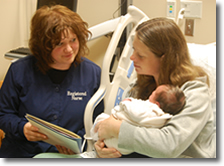
Nurse educating parent

On this page:
Introduction
Provider Responsibilities
Discussion Points


Introduction

The newborn screening system relies on members of the health care team to educate parents about newborn screening and its benefits. Parent awareness about the newborn screening process is important to alleviate anxiety about positive, borderline, or unsatisfactory newborn screening results. We have developed a variety of education materials to help guide discussions with parents.

Minnesota Statutes 144.125-144.128 and 144.966 require birth facilities and health care providers to inform parents about the benefits and risks of newborn screening, as well as the specific benefits and risks associated with choosing to opt-out of any part of newborn screening. The law also requires providers to document in the infant's medical record that the parents received information about newborn screening and had an opportunity to ask questions.


Provider Responsibilities

We recommend the following to meet the legal requirements:

  1. Provide and review the Newborn Screening Fact Sheet and Newborn Screening Infographic (highly recommended but not legally required) with parents. Both of these parent handouts are automatically sent to birth facilities and midwife practices with every newborn screening card. To view these handouts, visit our Education Materials and Forms (orderable) page.
     
  2. Inform parents that they have options after screening regarding the safe storage of their baby's blood spots and test results. These options are explained on the Newborn Screening Infographic. Visit our Retention Practices page for more information.
     
  3. Allow parents the opportunity to ask questions. Have forms available for parents who choose to refuse screening, give permission for research, or request destruction of blood spots and test results. All forms are available on our Education Materials and Forms (printable) page.
     
  4. Document in the newborn's medical record that the parents were given this information and that they had the opportunity to ask questions.

Discussion Points

If a parent is considering refusing newborn screening, it is important to review the following points:

  • Newborns with a disorder screened for by the Minnesota Newborn Screening Program often appear healthy at birth and have no family history of the disorder.
     
  • Newborns with these disorders can die, become developmentally delayed, or damage can be irreversible if not identified early by newborn screening.
     
  • The detection of hearing loss is delayed 1 or 2 years without newborn hearing screening. About 9 out of every 10 babies with hearing loss have hearing parents.
     
  • If a parent chooses to refuse screening, the parent must sign a refusal form. The parent's decision will be documented in the baby's medical record and sent to the Minnesota Department of Health Newborn Screening Program.
     
  • If a parent chooses to arrange for screening by a private laboratory, it is important to know that results may be delayed and follow-up will not be tailored to Minnesota's medical system. The disorders screened for by private laboratories may vary from those screened for by the Minnesota Department of Health Newborn Screening Program. Screening by a private laboratory should be arranged in advance.
Tags
  • newborn screening
Last Updated: 07/08/2025
  • Facebook
  • X
  • Instagram
  • LinkedIn
  • Youtube

About MDH

  • About Us
  • Grants and Loans
  • Advisory Committees

Legal & Accessibility

  • Privacy Policy
  • Equal Opportunity
  • Feedback Form

Careers at MDH

This is an official website of the State of Minnesota. Visit Minnesota.gov for more information.