
Contact Info
Ginny and Andy's Story - Meningococcal Disease
Ginny was not alarmed when her son Andy, a senior at the University of Kansas, called to say he wasn't feeling well. It was April 2004, and Andy was three weeks away from graduating college. In addition to finishing up his classes, he had been busy writing for a local weekly and the school newspaper. He described suddenly beginning to feel "awful" and having a difficult time "getting warm" despite the beautiful spring day. Assuming her son was tired and run down, Ginny told him he most likely had the flu and to rest and stay hydrated.
"I went to bed one night thinking I had the flu. The next morning, I couldn't get out of bed," Andy said. His body ached so badly that he refused to move, and his legs and arms were covered with purple blotches. Friends took Andy to the school health service where he was immediately seen by a doctor who suspected meningococcal disease. A spinal tap at the local hospital confirmed the diagnosis. Then an air ambulance took him to the University of Kansas Medical Center, about 40 miles away.
Ginny's husband received the first call from the health service. They said Andy was extremely ill, probably with meningococcal disease, a potentially fatal bacterial infection. Ginny and her husband caught the first flight from their home in Minnesota to Kansas City after receiving another call from Lawrence Memorial Hospital letting them know Andy did, in fact, have bacterial meningitis.
When Ginny and Harry reached the hospital, staff told them they had delayed putting Andy on a ventilator to assist his failing breathing because they wanted him to be able to say he loved them. They were told that, at best, Andy would lose fingers and toes, that he would likely be in kidney and possibly heart failure by the following day, and that death was a real threat.
Andy beat the odds and survived the disease, but there was still a long road ahead. He was in the medical intensive care unit for eight days and was then transferred to the burn unit ICU for several more weeks. The disease caused the equivalent of third degree burns over one-third of his body, requiring painful treatments. He spent about four and a half months in the hospital, undergoing at least half a dozen surgeries to amputate about one-third of each foot, all of his fingers except his right thumb, and half of his left.
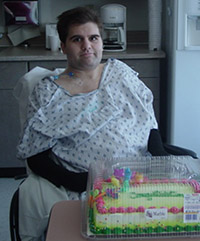
Even through all of this, Andy managed to graduate number one in his journalism class. He had to celebrate his graduation in the burn unit family room as he was still recovering. Andy spent over a year in rehabilitation and was finally able to start his journalism career in 2005. Since then, he has worked for several newspapers including the St. Cloud Times and Washington Post and is currently a legislative reporter for the Topeka Capitol-Journal. He received his master's degree in journalism in May 2011 and received three journalism awards in 2013. In between all of this, he has written a book about his experiences with meningococcal disease, Worth the Pain, that will be published in November of 2013.
Andy had not been vaccinated when he got sick; however, the strain he contracted was not included in the meningococcal vaccine. He has since been vaccinated and is a strong supporter of immunization to prevent meningococcal disease, so others don't have to go through what he did.
"I was one of the lucky ones. I survived," Andy said. "I lived to tell people about meningococcal disease, which I had barely heard of when I got it and tell people about the vaccines that can keep them from enduring the skin grafts and amputations and maybe even save their lives."
Ginny also works to educate others about the dangers of meningococcal disease and prevention methods, including immunization.
"As parents, we do everything we can to protect our children and ensure they remain healthy," said Ginny. "My hope is that parents recognize the dangers of meningococcal disease, a vaccine preventable illness, and the importance of prevention. The alternative can be death or significant disability."
More information on meningococcal disease
Anyone can get meningococcal disease, but adolescents and young adults are at increased risk for contracting the disease. The Centers for Disease Control and Prevention (CDC) recommends meningococcal immunization for all adolescents 11 through 18 years of age and college freshmen living in dormitories.