
Secondary menu

  • About Us
  • News & Stories
  • Translated Materials
Minnesota Department of Health logo
  • Data, Statistics, and Legislation

    Data, Statistics, and Legislation

    Statistical reports, health economics, policy, and legislation.
    Data, Statistics, and Legislation
    • Community Health
    • Diseases and Conditions
    • Environmental Health
    • Health Behaviors and Risk Factors
    • Health Care Cost and Quality
    • Reporting and Exchanging Data
    • Legislation and Policy
  • Diseases and Conditions

    Diseases and Conditions

    A-Z disease listing, diseases and conditions by type.
    Diseases and Conditions
  • Health Care Facilities, Providers, and Insurance

    Health Care Facilities and Providers

    Directories of facilities, professional certifications, health insurance and patient safety.
    Health Care Facilities and Providers
    • Facility Certification, Regulation and Licensing
    • Insurance
    • Health Information Technology
    • Provider Certifications, Licenses, Registrations and Rosters
    • Patient Health and Safety
    • Health Care Homes
    • Notices Related to Health Records
    • Rural Health and Primary Care
    • Trauma System
  • Healthy Communities, Environments, and Workplaces

    Healthy Communities, Environments, and Workplaces

    Indoor air and drinking water quality, community prevention and emergency preparedness.
    Healthy Communities, Environments, and Workplaces
    • Community Wellness and Health Equity
    • Healthy Schools and Child Care
    • Healthy Businesses and Workplaces
    • Local Public Health
    • Environments and Your Health
    • Safety and Prevention
    • Emergency Preparedness and Response
    • Equitable Health Care Task Force
    • Transforming the Public Health System in Minnesota
  • Individual and Family Health

    Individual and Family Health

    Birth records, immunizations, nutrition and physical activity.
    Individual and Family Health
    • Vital Records and Certificates
    • Disabilities and Special Health Needs
    • Disease Prevention and Symptom Management
    • Healthy Aging
    • Healthy Children, Youth and Adolescents
    • Mental Health and Well-being
    • Reproductive Rights and Protections in Minnesota
    • Women and Infants
MDH Logo

Breadcrumb

  1. Home
  2. Diseases and Conditions
  3. Infectious Disease Reporting
  4. Reportable Disease Rule (Communicable Disease Reporting Rule) Infectious Disease Reporting
Topic Menu

Infectious Disease Reporting

  • Infectious Disease Reporting Home
  • Reportable Diseases
  • Methods of Reporting
  • Persons Required to Report
  • Submitting Clinical Materials
  • Reporting Rule
    • Reportable Disease Poster
    • Disease Reporting and HIPAA
    • Amendment to Rules

Related Topics

  • Annual Summary of Disease Activity
  • Minnesota Electronic Disease Surveillance System (MEDSS)
  • Infectious Diseases A-Z
  • Reporting Blood Lead Test Results

Infectious Disease Reporting

  • Infectious Disease Reporting Home
  • Reportable Diseases
  • Methods of Reporting
  • Persons Required to Report
  • Submitting Clinical Materials
  • Reporting Rule
    • Reportable Disease Poster
    • Disease Reporting and HIPAA
    • Amendment to Rules

Related Topics

  • Annual Summary of Disease Activity
  • Minnesota Electronic Disease Surveillance System (MEDSS)
  • Infectious Diseases A-Z
  • Reporting Blood Lead Test Results
Contact Info
Infectious Disease Epidemiology, Prevention and Control Division
651-201-5414
IDEPC Comment Form

Contact Info

Infectious Disease Epidemiology, Prevention and Control Division
651-201-5414
IDEPC Comment Form

Rulemaking Basics
Amendment to Disease Reporting Rules

  • Amendment to Rules: Home

  • Comments

  • SONAR

  • Summary of Changes

The rulemaking process is governed by Minnesota Statutes, chapter 14 (Revisor: Chapter 14. Administrative procedure) , and Minnesota Rules, chapter 1400 (Revisor: Minnesota Rules, Chapter 1400, APA proceedings; expenses and attorney fees). 

This is a short summary of the main parts of the process, important documents, and timeline for developing and adopting rules.

Rule Revision Process
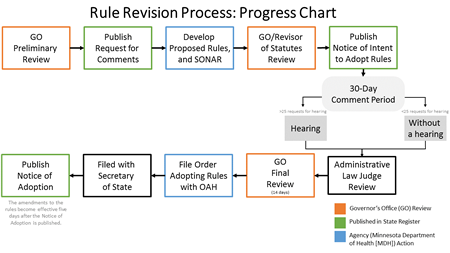
flow chart showing the process of rulemaking basics (see below for text)

  • Rule Revision Process: Progress Chart (PDF)

Request for Comments

The Request for Comments initiates the rulemaking process.

Statement of Need and Reasonableness (SONAR)

The Departments are required to justify that each rule requirement is needed and reasonable. “Needed” means that there are problems or a legislative directive that requires us to adopt or amend rules. “Reasonable” means that a proposed requirement is a reasonable solution to a problem. The justification will be in a document called the Statement of Need and Reasonableness (SONAR). Along with our analysis of each requirement in the rules, the SONAR also sets out our statutory authority for the rules and contains a modified cost/benefit analysis.

Review of proposed rules

The Revisor of Statutes will review the rules draft and edit, as necessary, for form and style.

Notice of intent to adopt rules

When we have finished writing the rules, we will publish in the State Register a Notice of Intent to Adopt Rules, along with the proposed rules. We will also mail the Notice and proposed rules to interested persons and to certain legislative committees.

30-day comment period

After the Notice of Intent to Adopt Rules is published, there is a 30-day comment period, during which persons may submit written comments on the proposed rules. Persons may also request a hearing on the rules during the 30-day comment period.

Rules hearing

If there are 25 hearing requests, the department is required to hold a hearing on the rules before an Administrative Law Judge (ALJ).

Review by Administrative Law Judge

Whether or not there is a hearing, an Administrative Law Judge (ALJ) review the proposed rules and all the documents from the rulemaking. The ALJ will approve the rules if the Departments have statutory authority for the rules, have shown the rules to be needed and reasonable, have given proper notice of the proposed rules, and has complied with all other rulemaking requirements.

Governor final/veto review

After the rules are adopted by MDH and approved by the ALJ, the Governor has 14 days to review them. The Governor may veto the rule amendments or let them become effective.

Notice of adoption

After the Governor’s review period, MDH will publish a Notice of Adoption in the State Register.

Effective date

The amendments to the rules become effective five days after the Notice of Adoption is published.


Timeline

This process of drafting amendments to the rules can be open-ended and we do not know when we will have a draft rule.

The formal part of the rulemaking process, from publishing the Notice of Intent to Adopt Rules until the date the rules become effective, takes about three months if there is no hearing and about five months if there is a hearing.


More information about the rulemaking process

  • MN House of Representatives: Rulemaking: Process for Adopting Rules (PDF)
Tags
  • reportable
Last Updated: 02/02/2026
  • Facebook
  • X
  • Instagram
  • LinkedIn
  • Youtube

About MDH

  • About Us
  • Grants and Loans
  • Advisory Committees

Legal & Accessibility

  • Privacy Policy
  • Equal Opportunity
  • Feedback Form

Careers at MDH

This is an official website of the State of Minnesota. Visit Minnesota.gov for more information.