
Secondary menu

  • About Us
  • News & Stories
  • Translated Materials
Minnesota Department of Health logo
  • Data, Statistics, and Legislation

    Data, Statistics, and Legislation

    Statistical reports, health economics, policy, and legislation.
    Data, Statistics, and Legislation
    • Community Health
    • Diseases and Conditions
    • Environmental Health
    • Health Behaviors and Risk Factors
    • Health Care Cost and Quality
    • Reporting and Exchanging Data
    • Legislation and Policy
  • Diseases and Conditions

    Diseases and Conditions

    A-Z disease listing, diseases and conditions by type.
    Diseases and Conditions
  • Health Care Facilities, Providers, and Insurance

    Health Care Facilities and Providers

    Directories of facilities, professional certifications, health insurance and patient safety.
    Health Care Facilities and Providers
    • Facility Certification, Regulation and Licensing
    • Insurance
    • Health Information Technology
    • Provider Certifications, Licenses, Registrations and Rosters
    • Patient Health and Safety
    • Health Care Homes
    • Notices Related to Health Records
    • Rural Health and Primary Care
    • Trauma System
  • Healthy Communities, Environments, and Workplaces

    Healthy Communities, Environments, and Workplaces

    Indoor air and drinking water quality, community prevention and emergency preparedness.
    Healthy Communities, Environments, and Workplaces
    • Community Wellness and Health Equity
    • Healthy Schools and Child Care
    • Healthy Businesses and Workplaces
    • Local Public Health
    • Environments and Your Health
    • Safety and Prevention
    • Emergency Preparedness and Response
    • Equitable Health Care Task Force
    • Transforming the Public Health System in Minnesota
  • Individual and Family Health

    Individual and Family Health

    Birth records, immunizations, nutrition and physical activity.
    Individual and Family Health
    • Vital Records and Certificates
    • Disabilities and Special Health Needs
    • Disease Prevention and Symptom Management
    • Healthy Aging
    • Healthy Children, Youth and Adolescents
    • Mental Health and Well-being
    • Reproductive Rights and Protections in Minnesota
    • Women and Infants
MDH Logo

Breadcrumb

  1. Home
  2. Diseases and Conditions
  3. Rabies
  4. Rabies Information For Health Professionals
Topic Menu

Rabies Risk

  • Rabies Information for Health Professionals: Rabies Risk Home
  • Bites to Humans
  • Human-Bat Encounters
  • Post-Exposure Prophylaxis Regimen
  • Pre-Exposure Prophylaxis Regimen
  • Animals Exposed to a Rabid Animal
  • Rabies Testing
  • Minnesota's Rabies Rules
  • References
  • Frequently Asked Questions
  • Contact Us

Related Topics

  • Rabies Home
  • Immunization
  • Illnesses from Animals
  • Infectious Diseases A-Z
  • Reportable Infectious Diseases

Rabies Risk

  • Rabies Information for Health Professionals: Rabies Risk Home
  • Bites to Humans
  • Human-Bat Encounters
  • Post-Exposure Prophylaxis Regimen
  • Pre-Exposure Prophylaxis Regimen
  • Animals Exposed to a Rabid Animal
  • Rabies Testing
  • Minnesota's Rabies Rules
  • References
  • Frequently Asked Questions
  • Contact Us

Related Topics

  • Rabies Home
  • Immunization
  • Illnesses from Animals
  • Infectious Diseases A-Z
  • Reportable Infectious Diseases
Contact Info
Infectious Disease Epidemiology, Prevention and Control Division
651-201-5414
IDEPC Comment Form

Contact Info

Infectious Disease Epidemiology, Prevention and Control Division
651-201-5414
IDEPC Comment Form

Rabies Information for Health Professionals

Reporting Rabies (animal and human cases and suspects)

Health care providers and clinical laboratories are required to report cases and suspect cases of rabies in an animal or human to MDH immediately 24 hours a day, seven days a week. Physicians and veterinarians may obtain information on rabies, including human exposure, prophylaxis, and bite management by calling 651-201-5414.
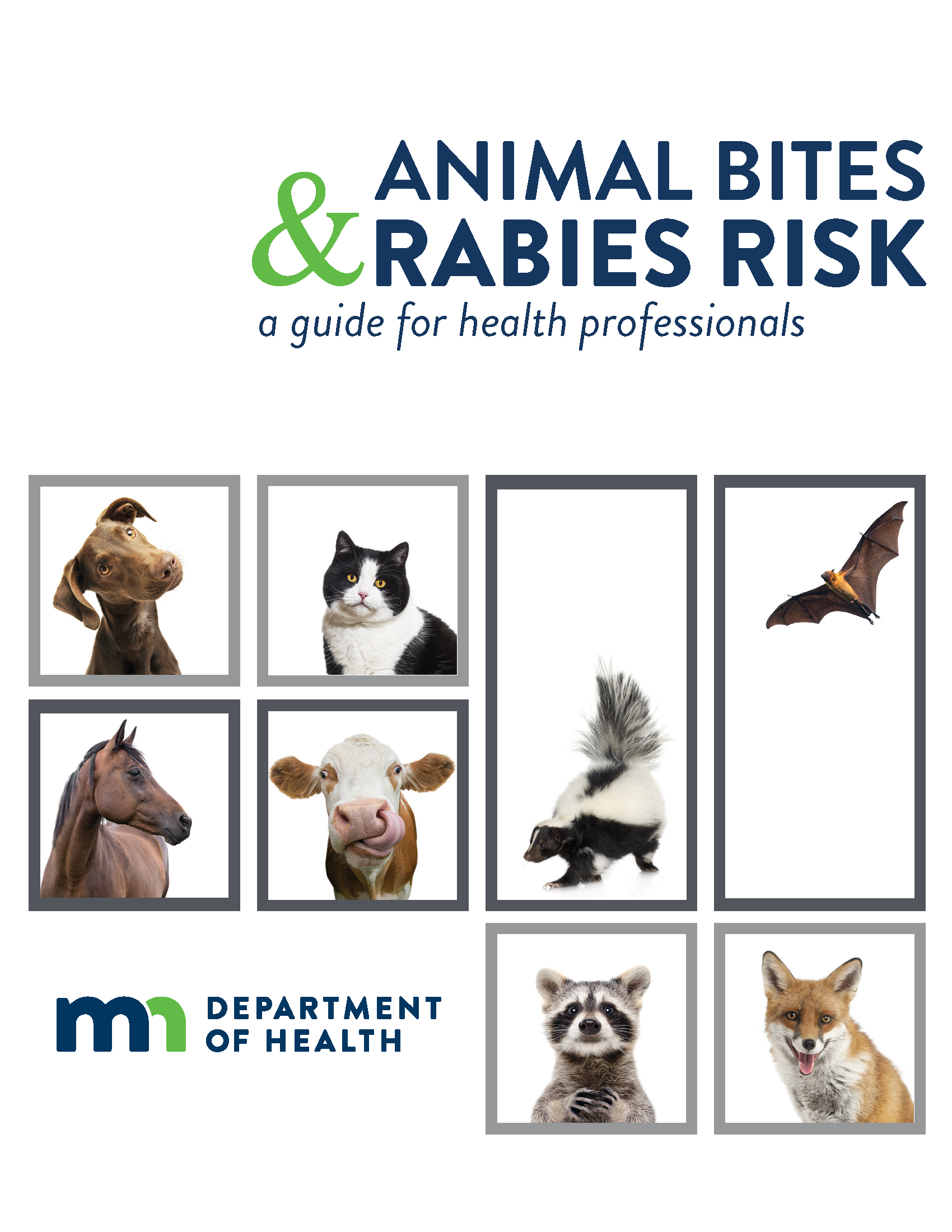

Animal Bites and Rabies Risk
  • Animal Bites and Rabies Risk: A Guide for Health Professionals (PDF) 
    This PDF file is the entire animal bites book, formatted for print. 
    Updated 1/2025, submission form modified 9/2025

Introduction

Rabies is a fatal neurologic illness transmitted to people by direct contact with the saliva of a rabid animal, normally through a bite. However, transmission through saliva or cerebral spinal fluid (CSF) contact with mucous membranes or a fresh wound or scratch is possible. The virus cannot penetrate intact skin. Rabies virus is inactivated rapidly by ultraviolet light or desiccation and does not persist in the environment; therefore, contact with the environment around a rabid animal such as bedding, or water bowls does not present a risk.

In Minnesota, rabies is found mainly in skunks and bats. Livestock and pets generally develop the disease following a bite from a rabid skunk. People are generally exposed to rabies by bats, livestock,and unvaccinated pets. Bites from wild carnivores and large rodents such as muskrats, groundhogs, and beavers are also of concern (see: Table 1: Human Rabies Risk Evaluation: Species of the Biting Animal (PDF) for species of concern). Species that are not a rabies risk in Minnesota include mice, hamsters, guinea pigs, gerbils, squirrels, chipmunks, rats, voles, and rabbits.

For more general information and current statistics on rabies in Minnesota see: Rabies.

  • Management of Animal Bites to Humans
    Consultations on animal bites and rabies risk, evaluation of the patient following animal bites, assessment of the need for rabies post-exposure prophylaxis, factors to consider when determining need for PEP.
  • Management of Human-Bat Encounters
    Bat encounters and bat bites, when a bat should be submitted for rabies testing, how to capture a bat and submit it for testing, assessment of the need for rabies PEP following a bat encounter.
  • Rabies Post-Exposure Prophylaxis (PEP) Regimen and Wound Care
    Wound care, Rabies PEP overview, human rabies immune globulin (HRIG), rabies vaccine, deviations from recommended PEP vaccination schedule, human rabies biologics, adverse reactions.
  • Rabies Pre-Exposure Prophylaxis Regimen (PrEV)
    Who should receive rabies pre-exposure prophylaxis, pre-exposure rabies vaccination series, antibody titers and booster vaccination, laboratories offering RFFIT rabies antibody titer testing.
  • Management of Animals Exposed to a Rabid Animal
    What to do when an animal is exposed to another animal.
  • Rabies Testing
    Guidelines for submitting suspect animals for rabies testing, laboratory testing, result reporting, result follow-up, rabies testing in humans.
    • Specimen Submission Form
       

  • Minnesota's Rabies Rules
  • References
  • Frequently Asked Questions
  • Contact Us
     
Tags
  • rabies
Last Updated: 09/05/2025
  • Facebook
  • X
  • Instagram
  • LinkedIn
  • Youtube

About MDH

  • About Us
  • Grants and Loans
  • Advisory Committees

Legal & Accessibility

  • Privacy Policy
  • Equal Opportunity
  • Feedback Form

Careers at MDH

This is an official website of the State of Minnesota. Visit Minnesota.gov for more information.