
Secondary menu

  • About Us
  • News & Stories
  • Translated Materials
Minnesota Department of Health logo
  • Data, Statistics, and Legislation

    Data, Statistics, and Legislation

    Statistical reports, health economics, policy, and legislation.
    Data, Statistics, and Legislation
    • Community Health
    • Diseases and Conditions
    • Environmental Health
    • Health Behaviors and Risk Factors
    • Health Care Cost and Quality
    • Reporting and Exchanging Data
    • Legislation and Policy
  • Diseases and Conditions

    Diseases and Conditions

    A-Z disease listing, diseases and conditions by type.
    Diseases and Conditions
  • Health Care Facilities, Providers, and Insurance

    Health Care Facilities and Providers

    Directories of facilities, professional certifications, health insurance and patient safety.
    Health Care Facilities and Providers
    • Facility Certification, Regulation and Licensing
    • Insurance
    • Health Information Technology
    • Provider Certifications, Licenses, Registrations and Rosters
    • Patient Health and Safety
    • Health Care Homes
    • Notices Related to Health Records
    • Rural Health and Primary Care
    • Trauma System
  • Healthy Communities, Environments, and Workplaces

    Healthy Communities, Environments, and Workplaces

    Indoor air and drinking water quality, community prevention and emergency preparedness.
    Healthy Communities, Environments, and Workplaces
    • Community Wellness and Health Equity
    • Healthy Schools and Child Care
    • Healthy Businesses and Workplaces
    • Local Public Health
    • Environments and Your Health
    • Safety and Prevention
    • Emergency Preparedness and Response
    • Equitable Health Care Task Force
    • Transforming the Public Health System in Minnesota
  • Individual and Family Health

    Individual and Family Health

    Birth records, immunizations, nutrition and physical activity.
    Individual and Family Health
    • Vital Records and Certificates
    • Disabilities and Special Health Needs
    • Disease Prevention and Symptom Management
    • Healthy Aging
    • Healthy Children, Youth and Adolescents
    • Mental Health and Well-being
    • Reproductive Rights and Protections in Minnesota
    • Women and Infants
MDH Logo

Breadcrumb

  1. Home
  2. Diseases and Conditions
  3. Cardiovascular Health
Topic Menu

Cardiovascular Health

  • Cardiovascular Health Home
  • CVH Data and Trends
  • CVH Programs & Resources
  • Minnesota 2035 Plan
  • Minnesota Stroke Program
  • About Us

Learn More

  • About Heart Attacks
  • About Heart Disease
  • About High Blood Pressure
  • About High Cholesterol
  • About Stroke

Related Topics

  • Chronic Conditions
  • Diabetes
  • Nutrition
  • Physical Activity
  • Tobacco


Cardiovascular Health

  • Cardiovascular Health Home
  • CVH Data and Trends
  • CVH Programs & Resources
  • Minnesota 2035 Plan
  • Minnesota Stroke Program
  • About Us

Learn More

  • About Heart Attacks
  • About Heart Disease
  • About High Blood Pressure
  • About High Cholesterol
  • About Stroke

Related Topics

  • Chronic Conditions
  • Diabetes
  • Nutrition
  • Physical Activity
  • Tobacco


Contact Info
Cardiovascular Health Program
health.heart@state.mn.us
health.stroke@state.mn.us

Contact Info

Cardiovascular Health Program
health.heart@state.mn.us
health.stroke@state.mn.us

Cardiovascular Health Indicator
Measure: Potentially Preventable Amputation Hospitalizations

Indicator Date of Most Recent Measure Current Measure Trend
Age-adjusted rate of hospitalization among adults with cardiovascular disease for lower-extremity amputations (eg. ankle, foot, and leg, but excluding toes) 2020 12.4
per
100,000
Stable
 
  • Overview
  • Analysis
  • Other Resources
  • Data Source & Definitions
 

Overview

  • Lower-extremity amputations are among the most serious consequences of Peripheral Artery Disease (PAD). PAD narrows the arteries in the legs, which limits blood flow to the muscles. People with diabetes, obesity, high blood pressure or high cholesterol, and people who smoke have a higher risk of developing PAD.
  • In 2020, there were 614 hospitalizations of Minnesotans which included cardiovascular disease-related lower-extremity amputation, or a rate of 12.4 hospitalizations per 100,000 people.
  • The total number of cardiovascular disease-related lower-extremity amputations have ranged 498 at the low end to 665 at the high end over the 2006-2020 period. The lowest rate of 10.7 per 100,000 people occurred in 2016, with a stable rate at a slightly higher level since then.
 

Analysis

As shown in Table 1 and Chart 1, the hospitalization rate for cardiovascular-disease related lower-extremity amputations has declined from their highest levels in 2006 and 2007. In recent years, the rate has been steady, but it is higher than the recent lowest rate recorded in 2016. Over this 15-year time period, the total number of hospitalizations has remained in a fairly narrow range, from 498 at the low end to 665 at the high end.

Table 1: Total Cardiovascular Disease-related Lower Extremity Amputation Hospitalizations and Hospitalization Rate for Adult Minnesotans, 2006-2020

Year Number of Hospitalizations Age-adjusted Hospitalization Rate (per 100,000) 95% Confidence Interval
2006 665 16.9 15.6-18.2
2007 576 14.3 13.1-15.4
2008 498 12.0 11.0-13.1
2009 552 13.2 12.1-14.3
2010 529 12.3 11.2-13.3
2011 501 11.5 10.5-12.5
2012 579 13.0 11.9-14.1
2013 577 12.7 11.6-13.7
2014 640 13.9 12.8-14.9
2015 576 12.1 11.1-13.1
2016 510 10.7 9.8-11.6
2017 561 11.6 10.7-12.6
2018 622 12.7 11.7-13.7
2019 615 12.3 11.3-13.2
2020 614 12.4 11.4-13.4

Chart 1: Total Hospitalization Rate for Cardiovascular Disease-related Lower Extremity Amputations for Adult Minnesotans, 2006-2020
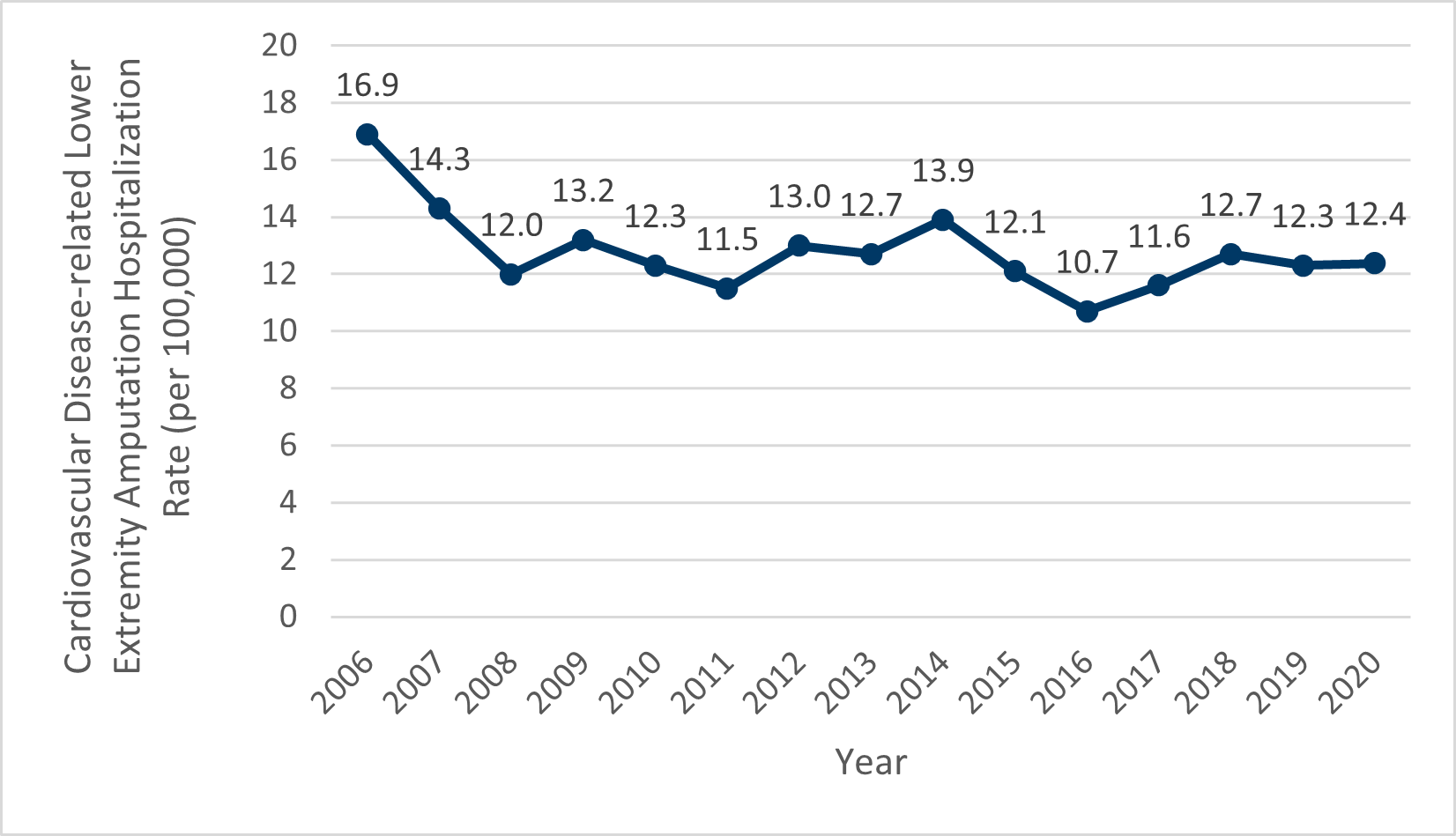
Chart 1, see table 1 below for details.


Other Resources

  • Potentially Preventable Health Care Events in Minnesota (PDF)
    This recent report from the Health Economics Program at the Minnesota Department of Health on at the number and cost of potentially preventable emergency department, hospitalization, and rehospitalization events in Minnesota. It has more discussion of what potentially preventable events are and how they may be prevented. Because it also looks at emergency department data, the report gives a fuller picture of how people interact with health care providers and may help to interpret the data shown here.

    Note: this report uses different metrics to define potentially preventable hospitalizations which are different from the specifications used for this indicator.


  •  

Data Source

The data were obtained through the Minnesota Hospital Discharge Dataset, also known as the Minnesota Hospital Uniform Billing (UB) Claims Data, provided to the Health Economics Program at the Minnesota Department of Health by the Minnesota Hospital Association. The dataset captures hospitalizations for Minnesota residents and comes from Minnesota hospitals (except for Federal Hospitals owned by the Veterans Administration or the Indian Health Service) or other states that share data with the state of Minnesota (including the bordering states of Iowa, North Dakota, and South Dakota; hospitalizations that occur in Wisconsin for Minnesota residents are not included/shared). Annual population estimates were obtained through the U.S. Census Bureau in collaboration with the National Center for Health Statistics.

Measure Definition

Definitions for this indicator is available through the Agency for Healthcare Research and Quality (AHRQ).The lower-extremity amputation measure was modified from the AHRQ definition by replacing diabetes diagnosis codes with circulatory disease diagnoses (ICD-9: 390 -459 through September 30, 2015 and ICD-10: I00-I99). Adult measures were age-adjusted to the U.S. 2000 adult standard population weights.

The change from ICD-9 to ICD-10 introduces some uncertainty in the trend from 2014 through 2016, because changes in coding may lead to differences in classification of conditions before and after the transition.


Return to top

Tags
  • cardiovascular
Last Updated: 01/05/2023
  • Facebook
  • X
  • Instagram
  • LinkedIn
  • Youtube

About MDH

  • About Us
  • Grants and Loans
  • Advisory Committees

Legal & Accessibility

  • Privacy Policy
  • Equal Opportunity
  • Feedback Form

Careers at MDH

This is an official website of the State of Minnesota. Visit Minnesota.gov for more information.