
What are Public Narratives?
All people understand and make sense of the world through images and stories. A narrative is a story that connects issues, actions, and values.
For example, imagine a story about growing up in a farming community, when joined one another to cook meals, take care of animals, and tend the fields for a family that had experienced a tragedy. This story expresses values of family, community, belonging, and doing good for others. The connection to values makes the story more powerful.
Public narratives (rather than personal or family narratives) are narratives that many people share. They often reflect deeply held cultural perspectives and arise out of a shared history.
For example, a common story in the U.S. is about an immigrant ancestor who came to this country, worked hard, and succeeded against all odds. This narrative taps into deeply held and widely shared values about the importance of individual effort and freedom to chart one’s own life course.
Public narratives are especially powerful in their influence on public policy decisions. The narrative that focuses on individual effort leads to policies that emphasize individual autonomy. The common narrative about the hard-working and ultimately successful immigrant, for example, focuses on the effort of one person and tends to forget that a whole network of people and conditions made their success possible. Such a story leaves out how family members, a welcoming community, the color of their skin, fair wages, free education, or other factors supported and enabled their success. Elevating those parts of the story helps direct policy action to support families, the community, justice, and opportunity.
The role of public narratives in advancing health equity
Policy decisions create the conditions for health—conditions that include who has access to good schools, where businesses locate jobs, and who pays for health care. It is essential, therefore, to be aware of the narratives that are behind public policy decisions and to advance narratives that will support efforts for health and health equity.
Narratives that dominate the public sphere—the ones that are familiar and are repeated the most often—have more power than other ways of thinking. One prevailing public narrative about health in American culture is the idea that health somehow comes from a visit to the doctor’s office. Another prevailing narrative is that health is the sole responsibility of the individual, who should engage in “healthy behavior” like exercising more or eating less. These narratives reflect common American values of respect for individuals, scientific expertise (the doctor knows more), and rugged individualism (that people should be able to help themselves without government assistance).
Behaviors like these, however, are strongly influenced by the social and economic conditions in which people live, work, learn, and play. For example, no matter how much they may want to, children can’t get fresh air and exercise if they have no safe place to play outside. Moreover, as important as health care is, periodic visits to the doctor cannot hope to overcome the daily challenges to health that many people face. By intentionally creating broader and more inclusive narratives about the factors that create or hinder health—education, employment, transportation, and more—people can develop a more complete and realistic understanding of the problem and explore new and different solutions.
When conversations about health are only about health care, health policy discussions become limited to health care issues and strategies for improving health care services. Similarly, if conversations about health never move beyond individual behaviors, solutions will miss the way policies shape the conditions for health.
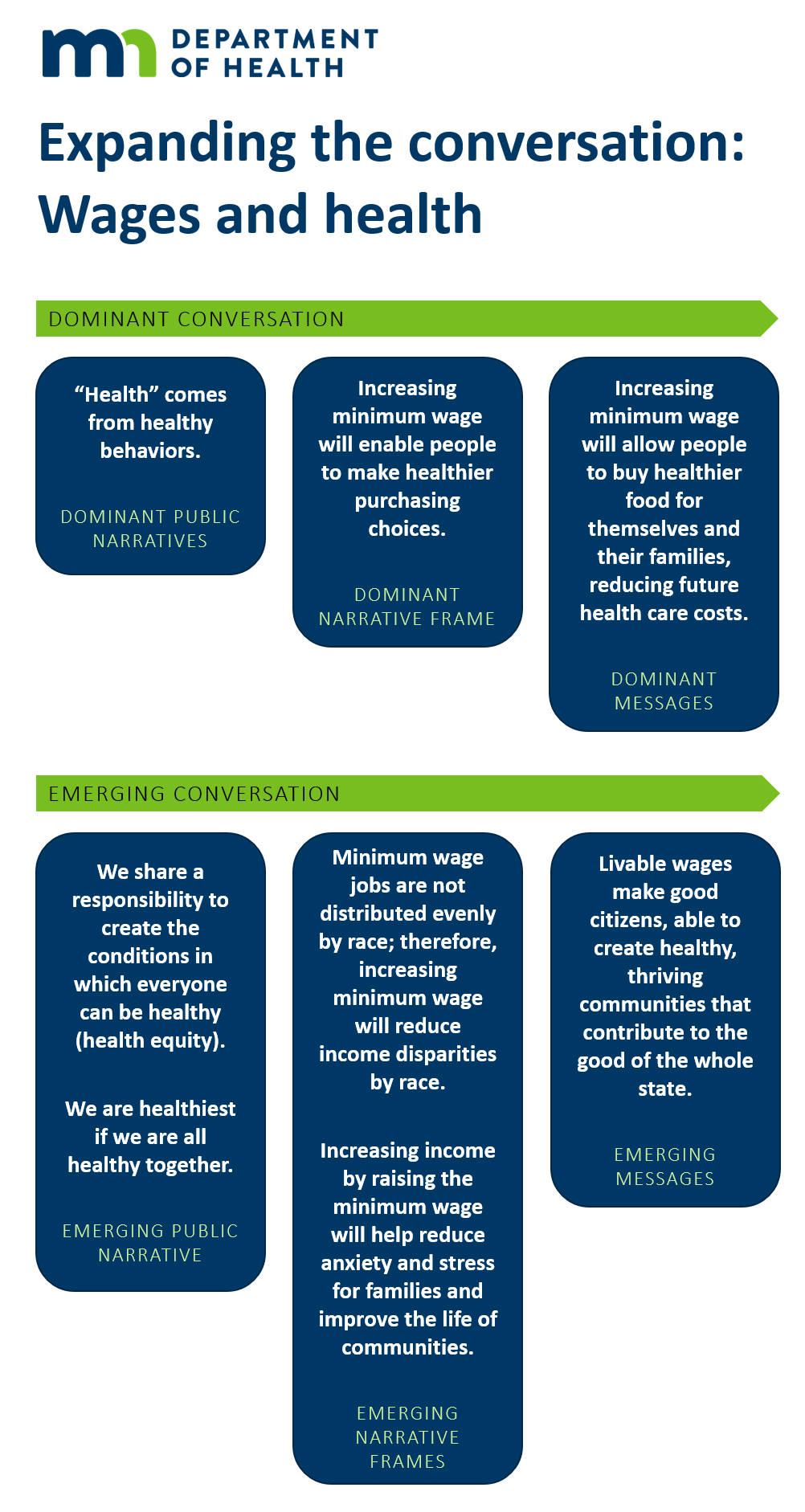
Expanded conversations, however, can advance a wider set of solutions, including policies for improved population health. Conversations based on narratives about the conditions in which people can be healthy—such as assuring people have a place to call home, supporting family life, promoting belonging in school, and shaping healthy environments—increased the potential to advance health equity. Working to open up conversations about what and who creates health is a method the Healthy Minnesota Partnership chose for moving into new possibilities.