Secondary menu

  • About Us
  • News & Stories
  • Translated Materials
Minnesota Department of Health logo
  • Data, Statistics, and Legislation

    Data, Statistics, and Legislation

    Statistical reports, health economics, policy, and legislation.
    Data, Statistics, and Legislation
    • Community Health
    • Diseases and Conditions
    • Environmental Health
    • Health Behaviors and Risk Factors
    • Health Care Cost and Quality
    • Reporting and Exchanging Data
    • Legislation and Policy
  • Diseases and Conditions

    Diseases and Conditions

    A-Z disease listing, diseases and conditions by type.
    Diseases and Conditions
  • Health Care Facilities, Providers, and Insurance

    Health Care Facilities and Providers

    Directories of facilities, professional certifications, health insurance and patient safety.
    Health Care Facilities and Providers
    • Facility Certification, Regulation and Licensing
    • Insurance
    • Health Information Technology
    • Provider Certifications, Licenses, Registrations and Rosters
    • Patient Health and Safety
    • Health Care Homes
    • Notices Related to Health Records
    • Rural Health and Primary Care
    • Trauma System
  • Healthy Communities, Environments, and Workplaces

    Healthy Communities, Environments, and Workplaces

    Indoor air and drinking water quality, community prevention and emergency preparedness.
    Healthy Communities, Environments, and Workplaces
    • Community Wellness and Health Equity
    • Healthy Schools and Child Care
    • Healthy Businesses and Workplaces
    • Local Public Health
    • Environments and Your Health
    • Safety and Prevention
    • Emergency Preparedness and Response
    • Equitable Health Care Task Force
    • Transforming the Public Health System in Minnesota
  • Individual and Family Health

    Individual and Family Health

    Birth records, immunizations, nutrition and physical activity.
    Individual and Family Health
    • Vital Records and Certificates
    • Disabilities and Special Health Needs
    • Disease Prevention and Symptom Management
    • Healthy Aging
    • Healthy Children, Youth and Adolescents
    • Mental Health and Well-being
    • Reproductive Rights and Protections in Minnesota
    • Women and Infants
MDH Logo

Breadcrumb

  1. Home
  2. Healthy Communities, Environment and Workplaces
  3. Emergency Preparedness and Response
Topic Menu

Emergency Preparedness and Response

  • Emergency Preparedness Home
  • Family and Community Preparedness
  • Disaster Mental/Behavioral Health
  • HAN
  • Medical Countermeasures
  • Plans
  • Minnesota Responds
  • Training & Exercises
  • Health Care Coalitions
  • Long-Term Care
  • Medical Surge
  • About EPR

Emergency Preparedness and Response

  • Emergency Preparedness Home
  • Family and Community Preparedness
  • Disaster Mental/Behavioral Health
  • HAN
  • Medical Countermeasures
  • Plans
  • Minnesota Responds
  • Training & Exercises
  • Health Care Coalitions
  • Long-Term Care
  • Medical Surge
  • About EPR
Contact Info
Emergency Preparedness and Response
651-201-5700
Emergency Preparedness & Response Comment Form

Contact Info

Emergency Preparedness and Response
651-201-5700
Emergency Preparedness & Response Comment Form

Determining Total Body Surface Area

Wallace Rule of Nines and Palmar Method

PDF version for print: Determining Total Body Surface Area (PDF)
Courtesy of the American Burn Association.

Rule of Nines Adults (Age ≥ 14 years)
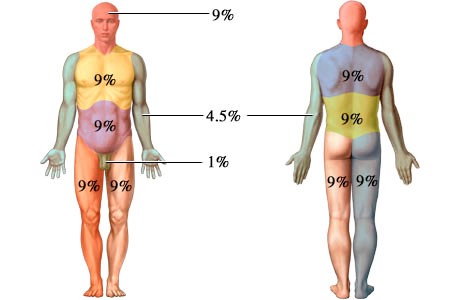
Rule of Nine for Adults:
Anterior side of body:
Head and neck 9%
Upper Thorax 9%
Lower Thorax 9%
Right Leg 9%
Left Leg 9%
Right Arm 4.5%
Left Arm 4.5%
Perineum 1%
Poster side of body:
Head and neck 9%
Upper Thorax 9%
Lower Thorax 9%
Right Leg 9%
Left Leg 9%
Right Arm 4.5%
Left Arm 4.5%

Role of Nines for Children (Age 1-14 years)
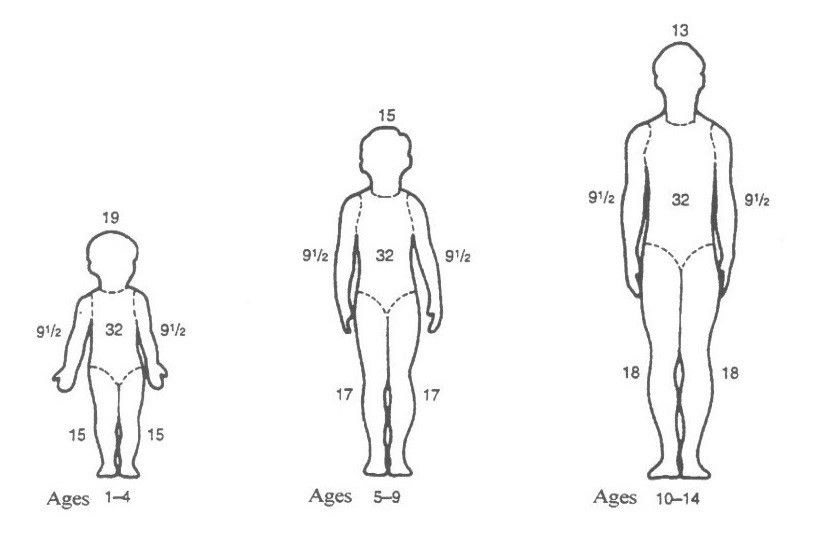
Rule of Nines for children (1-14):
Child ages 1-4:
Head 19%
Each Arm 9.5%
Thorax 32%
Each Leg 15%
Child ages 5-9:
Head 15%
Each Arm 9.5%
Thorax 32%
Each Leg 17%
Child ages 10-14
Head 13%
Each Arm 9.5%
Thorax 32%
Each Leg 18%

Rule of Nines for Infant (Age < 1 year)
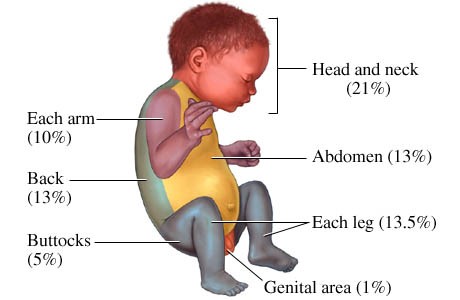
Rule of Nine for Infant:
Head and Neck 21%
Each Arm 10%
Abdomen 13%
Each Leg 13.5%
Genital Area 1%
Back 13%
Buttocks 5%

Palmar Method

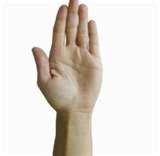
mage of palm to represent using the palm of burn victim to estimate total body surface area.
Palm of patient is approximately 1% of surface area

Estimate with fingers positioned together as above. Utilize the patient's palm size not your own.

The Palmar Method of estimating total body surface area (TBSA) is an easy way to get a rough burn size estimate that can be used when calculating a patients fluid resuscitation needs.

The patient’s palmar surface including their fingers = 1% TBSA

Courtesy of the American Burn Association.

Tags
  • emergency preparedness
Last Updated: 10/23/2024
  • Facebook
  • X
  • Instagram
  • LinkedIn
  • Youtube

About MDH

  • About Us
  • Grants and Loans
  • Advisory Committees

Legal & Accessibility

  • Privacy Policy
  • Equal Opportunity
  • Feedback Form

Careers at MDH

This is an official website of the State of Minnesota. Visit Minnesota.gov for more information.