Secondary menu

  • About Us
  • News & Stories
  • Translated Materials
Minnesota Department of Health logo
  • Data, Statistics, and Legislation

    Data, Statistics, and Legislation

    Statistical reports, health economics, policy, and legislation.
    Data, Statistics, and Legislation
    • Community Health
    • Diseases and Conditions
    • Environmental Health
    • Health Behaviors and Risk Factors
    • Health Care Cost and Quality
    • Reporting and Exchanging Data
    • Legislation and Policy
  • Diseases and Conditions

    Diseases and Conditions

    A-Z disease listing, diseases and conditions by type.
    Diseases and Conditions
  • Health Care Facilities, Providers, and Insurance

    Health Care Facilities and Providers

    Directories of facilities, professional certifications, health insurance and patient safety.
    Health Care Facilities and Providers
    • Facility Certification, Regulation and Licensing
    • Insurance
    • Health Information Technology
    • Provider Certifications, Licenses, Registrations and Rosters
    • Patient Health and Safety
    • Health Care Homes
    • Notices Related to Health Records
    • Rural Health and Primary Care
    • Trauma System
  • Healthy Communities, Environments, and Workplaces

    Healthy Communities, Environments, and Workplaces

    Indoor air and drinking water quality, community prevention and emergency preparedness.
    Healthy Communities, Environments, and Workplaces
    • Community Wellness and Health Equity
    • Healthy Schools and Child Care
    • Healthy Businesses and Workplaces
    • Local Public Health
    • Environments and Your Health
    • Safety and Prevention
    • Emergency Preparedness and Response
    • Equitable Health Care Task Force
    • Transforming the Public Health System in Minnesota
  • Individual and Family Health

    Individual and Family Health

    Birth records, immunizations, nutrition and physical activity.
    Individual and Family Health
    • Vital Records and Certificates
    • Disabilities and Special Health Needs
    • Disease Prevention and Symptom Management
    • Healthy Aging
    • Healthy Children, Youth and Adolescents
    • Mental Health and Well-being
    • Reproductive Rights and Protections in Minnesota
    • Women and Infants
MDH Logo

Breadcrumb

  1. Home
  2. Healthy Communities, Environment and Workplaces
  3. Environments and Your Health
  4. Environmental Laboratory
Topic Menu

Environmental Laboratory

  • Environmental Laboratory Home
  • Sample Drop-Off Instructions
  • Bottle Order Portal
  • Client Resources
  • Element Client Connect
  • Safety Data Sheets
  • Customer Survey

Related Topics

  • Public Health Laboratory Home
  • MDA/MDH Laboratory Building Map (PDF)

Environmental Laboratory

  • Environmental Laboratory Home
  • Sample Drop-Off Instructions
  • Bottle Order Portal
  • Client Resources
  • Element Client Connect
  • Safety Data Sheets
  • Customer Survey

Related Topics

  • Public Health Laboratory Home
  • MDA/MDH Laboratory Building Map (PDF)
Contact Info
PHL Environmental Laboratory
651-201-5300
health.mdhlab@state.mn.us

Contact Info

PHL Environmental Laboratory
651-201-5300
health.mdhlab@state.mn.us

Environmental Laboratory

Instructions for environmental sample collectors and submitters

At this time, the Environmental Sample Receiving Unit and Laboratory Operations of the Minnesota Public Health Lab are open and available to receive samples following our usual Monday-Friday 8:00 a.m. to 4:30 p.m. schedule.

If samples with regulated hold times of 48 hours or less must be delivered to our laboratory after 12 p.m. on Fridays, we ask that all collectors notify our laboratory before 12 p.m. on Fridays and indicate the type of analysis and number of samples to be submitted.

Communication can either be via phone at (651) 201-5300 or email at HEALTH.Env.OperationsUnit@state.mn.us with a subject line of Friday Submission. Please follow the Sample Drop-off Instructions for instructions for Social Distancing Requirements.
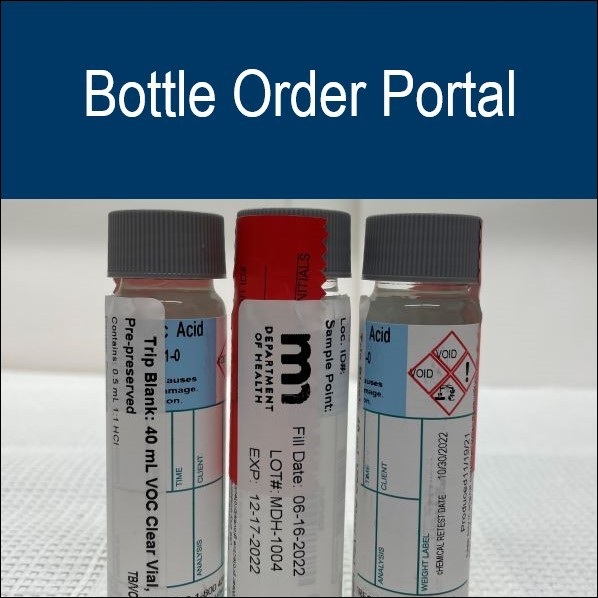
Bottle Order Portal banner, with vials
Sampling and Analysis Guide (PDF) banner, with image of guide
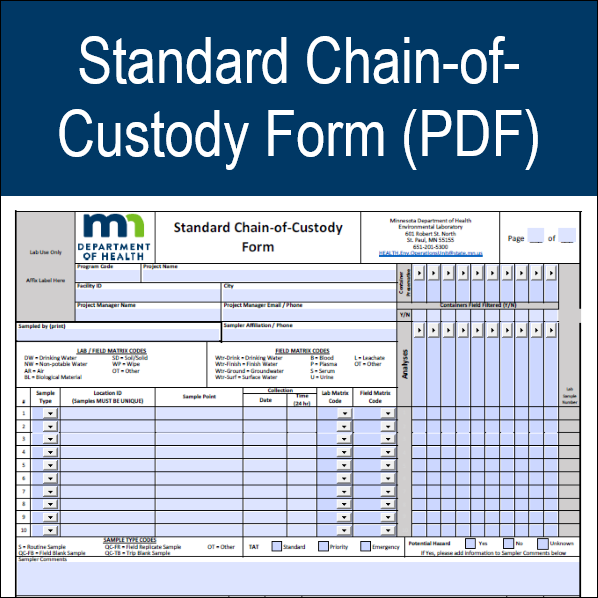
Standard Chain of Custody Form (PDF) banner, with image of form

More information:

  • Client Resources
  • Element Client Connect
  • Safety Data Sheets
  • Sample Drop-Off Instructions

Resources for submitters:

  • Bottle Order Portal
  • Environmental Laboratory Sampling and Analysis Guide (PDF: 2MB/60 pages)
  • Standard Chain-of-Custody Form (PDF)

About the Environmental Laboratory
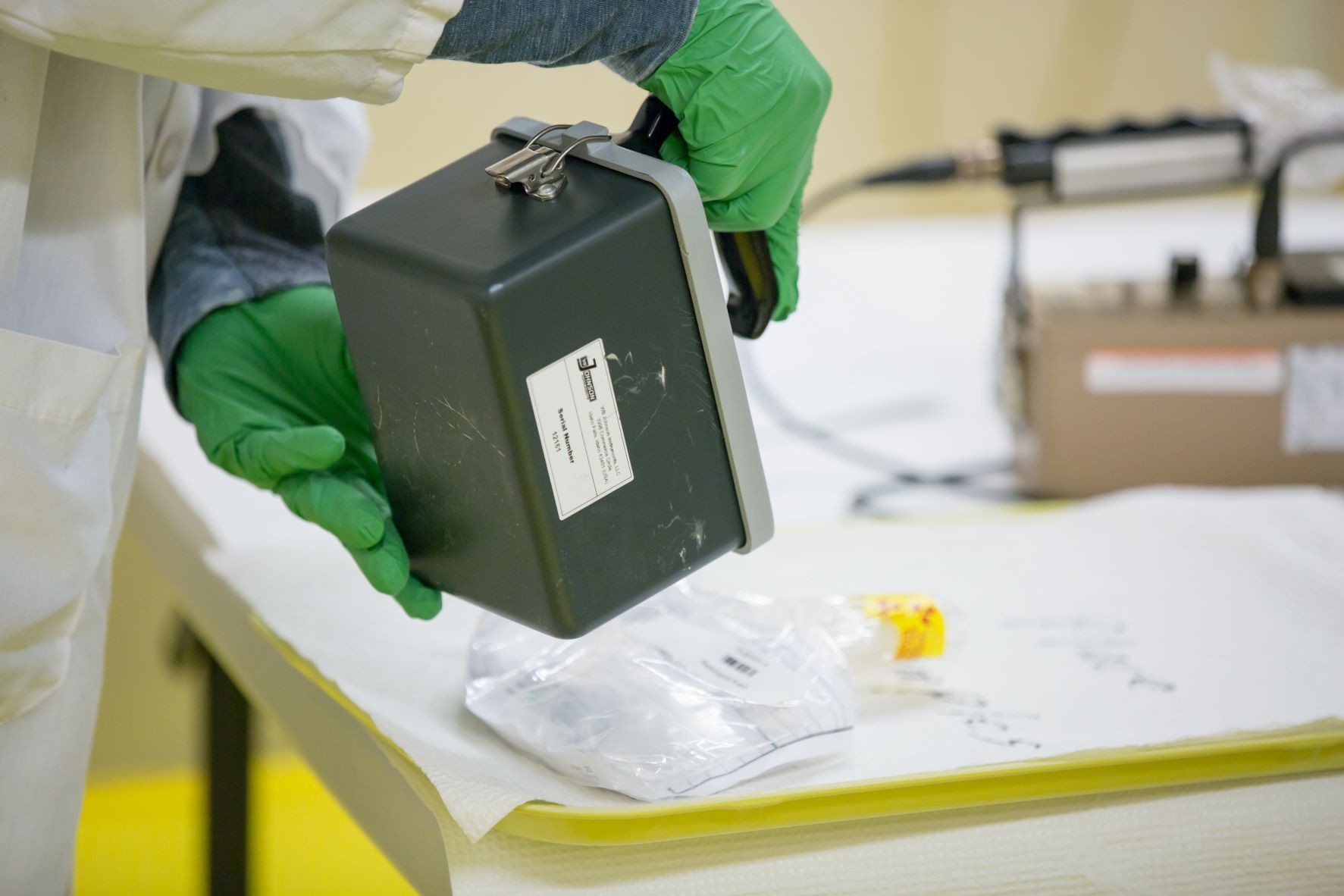
Environmental Laboratory scientist conducting a testThe Environmental Laboratory, a section of the Minnesota Public Health Laboratory, tests approximately 44,000 samples annually for a wide breadth of potential threats to human and environmental health, including E. coli, nitrates, sulfates, cyanobacteria, legionella, pesticides, and many more. We perform chemical, bacteriological and radiological analyses of samples of drinking water, surface water, wastewater, sediment, air, fish, food products, soil, human waste, and hazardous waste.

The Environmental Laboratory is currently leading a nationwide effort to monitor the "forever chemical" known as PFAS. Visit the Environmental Health Division's Per- and Polyfluoroalkyl Substances (PFAS) section and the Minnesota Pollution Control Agency's PFAS Blueprint for more information.

We provide these testing services for programs in the Environmental Health Division, which is also part of the Minnesota Department of Health, as well as for the Minnesota Pollution Control Agency, the Minnesota Department of Transportation, the Food Emergency Response Network (FERN), and for many other agencies of local and federal government. Additionally, we assist law enforcement by analyzing suspicious packages and other substances for dangerous chemical and biological agents.

In partnership with the Public Health Laboratory's Infectious Disease Laboratory, we also maintain a Laboratory Emergency Response program. This work sustains the capability to immediately respond to biological, chemical, and radiological emergencies. The Environmental Laboratory works with Minnesota's two nuclear power plants in this capacity.

In addition, we develop new analytical methods and provide technical training and consultation at the request of our clients. Our mission is to ensure that testing capacity is available to support the public health and environmental protection objectives of the state of Minnesota.

The Environmental Laboratory includes the technical areas of General Chemistry, Metals Chemistry, Organic Chemistry, Radiation Chemistry, and Water Microbiology.

Tags
  • environment
Last Updated: 12/02/2024
  • Facebook
  • X
  • Instagram
  • LinkedIn
  • Youtube

About MDH

  • About Us
  • Grants and Loans
  • Advisory Committees

Legal & Accessibility

  • Privacy Policy
  • Equal Opportunity
  • Feedback Form

Careers at MDH

This is an official website of the State of Minnesota. Visit Minnesota.gov for more information.