
Secondary menu

  • About Us
  • News & Stories
  • Translated Materials
Minnesota Department of Health logo
  • Data, Statistics, and Legislation

    Data, Statistics, and Legislation

    Statistical reports, health economics, policy, and legislation.
    Data, Statistics, and Legislation
    • Community Health
    • Diseases and Conditions
    • Environmental Health
    • Health Behaviors and Risk Factors
    • Health Care Cost and Quality
    • Reporting and Exchanging Data
    • Legislation and Policy
  • Diseases and Conditions

    Diseases and Conditions

    A-Z disease listing, diseases and conditions by type.
    Diseases and Conditions
  • Health Care Facilities, Providers, and Insurance

    Health Care Facilities and Providers

    Directories of facilities, professional certifications, health insurance and patient safety.
    Health Care Facilities and Providers
    • Facility Certification, Regulation and Licensing
    • Insurance
    • Health Information Technology
    • Provider Certifications, Licenses, Registrations and Rosters
    • Patient Health and Safety
    • Health Care Homes
    • Notices Related to Health Records
    • Rural Health and Primary Care
    • Trauma System
  • Healthy Communities, Environments, and Workplaces

    Healthy Communities, Environments, and Workplaces

    Indoor air and drinking water quality, community prevention and emergency preparedness.
    Healthy Communities, Environments, and Workplaces
    • Community Wellness and Health Equity
    • Healthy Schools and Child Care
    • Healthy Businesses and Workplaces
    • Local Public Health
    • Environments and Your Health
    • Safety and Prevention
    • Emergency Preparedness and Response
    • Equitable Health Care Task Force
    • Transforming the Public Health System in Minnesota
  • Individual and Family Health

    Individual and Family Health

    Birth records, immunizations, nutrition and physical activity.
    Individual and Family Health
    • Vital Records and Certificates
    • Disabilities and Special Health Needs
    • Disease Prevention and Symptom Management
    • Healthy Aging
    • Healthy Children, Youth and Adolescents
    • Mental Health and Well-being
    • Reproductive Rights and Protections in Minnesota
    • Women and Infants
MDH Logo

Breadcrumb

  1. Home
  2. Healthy Communities, Environment and Workplaces
  3. Health Equity
  4. About The Health Equity Strategy and Innovation Division
Topic Menu

Health Equity

  • Health Equity Home
  • Capacity Building Requests
  • Funding Opportunities
  • Newsletters
  • Reports and Publications
  • Health Equity Networks

About Us

  • Division of Health Equity Strategy and Innovation
  • Office American Indian Health
  • Office of African American Health
  • Office of Diversity, Inclusion, Belonging, and Equity Strategy

Health Equity

  • Health Equity Home
  • Capacity Building Requests
  • Funding Opportunities
  • Newsletters
  • Reports and Publications
  • Health Equity Networks

About Us

  • Division of Health Equity Strategy and Innovation
  • Office American Indian Health
  • Office of African American Health
  • Office of Diversity, Inclusion, Belonging, and Equity Strategy
Contact Info
Health Equity Strategy and Innovation Division
651-201-5813
health.equity@state.mn.us

Contact Info

Health Equity Strategy and Innovation Division
651-201-5813
health.equity@state.mn.us

Four runners at a starting line and one other runner starting far behind themCreating 
Health Equity 
in Minnesota

Minnesota, on average, ranks among the healthiest states in the nation. But those averages do not tell the whole story. Minnesota has some of the greatest health disparities in the country between whites and people of color and American Indians. Why is this? and What can Minnesota do to advance health equity?

What makes us healthy?

What creates health? The common belief is that good health is due to personal choices and great medical care. These do influence health and are important. But the reality is that clinical care is a relatively small contributor to overall health - around 10 percent. Some models suggest that the biggest contributors to health are socio-economic factors like education, income, individual and community-level wealth, mobility and housing.

It is not surprising that Minnesota has some of the worst health disparities in the country, because it has significant inequalities in areas such as income, education and home ownership.
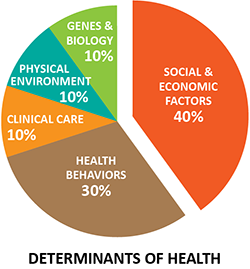
Pie chart of the social determinants of health: genes and biology 10%, physical environment 10%, clinical care 10%, health behaviors 30%, social and economic factors 40%

Finding a solution

To be healthy, people need peace, shelter, education, food, income, and social justice. In short, health is created where people live, work, and play. Minnesota's significant and long-lasting health inequities cannot be explained by bio-genetic factors and personal choice. These health differences have in part resulted from structural racism, which refers to racism that is built into systems and policies, rather than individual prejudice. Creating health equity requires a comprehensive solution that includes but goes beyond targeted grants and access to health care. Minnesota needs to address health disparities as part of a broad spectrum of public investments in housing, transportation, education, economic opportunity and criminal justice. Learn more about Minnesota's approach in the Advancing Health Equity Report.

Tags
  • equity
Last Updated: 07/24/2024
  • Facebook
  • X
  • Instagram
  • LinkedIn
  • Youtube

About MDH

  • About Us
  • Grants and Loans
  • Advisory Committees

Legal & Accessibility

  • Privacy Policy
  • Equal Opportunity
  • Feedback Form

Careers at MDH

This is an official website of the State of Minnesota. Visit Minnesota.gov for more information.